

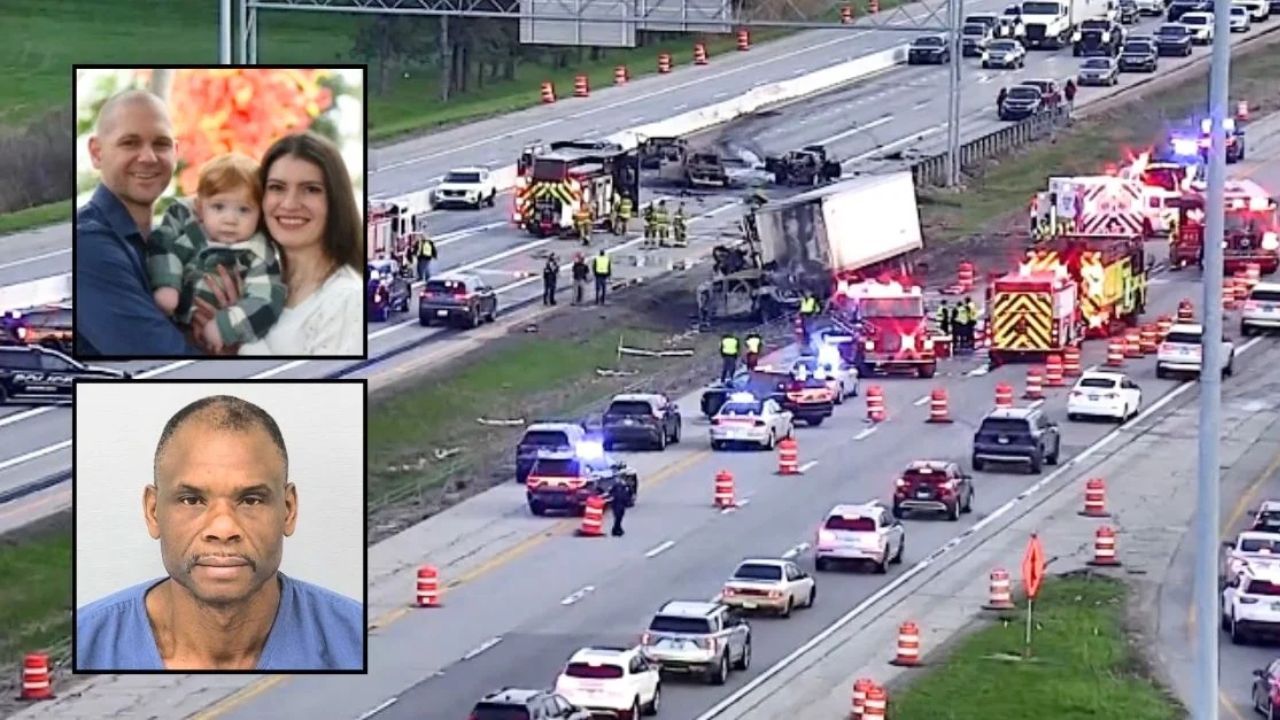
A family of three lost their lives in a devastating highway crash in Ohio after a semi-truck slammed into stopped traffic, triggering a chain-reaction collision involving nine vehicles. Now, the truck driver responsible has learned his fate and will spend more than two decades behind bars.
Modou Ngom, 51, was sentenced to 22½ years in prison after being convicted of three counts of aggravated vehicular homicide and five counts of vehicular assault. Delaware County Common Pleas Court Judge Marianne Hemmeter handed down the maximum possible prison sentence following his conviction.
The victims were 37-year-old Luke Soposki, his 36-year-old wife, Lynnea Soposki, and their 1-year-old son, Logan.
Five other people were seriously injured in the crash, leaving multiple families dealing with physical injuries and lasting emotional trauma.
For the Soposki family, the consequences were irreversible. A routine drive ended with three lives lost and a young child never getting the chance to grow up.
What happened on Interstate 71?
The deadly collision happened on April 11, when Ngom was operating a 2006 Freightliner semi-truck along Interstate 71 in Delaware County, north of Columbus.
Traffic ahead had slowed and eventually come to a stop. While other motorists were reducing their speed, investigators determined that Ngom continued traveling at a high rate of speed.
According to the allegations described in a civil lawsuit, the truck driver failed to slow down before crashing into vehicles ahead of him.
The impact set off a chain reaction involving nine vehicles.
Traffic footage captured the frightening moments as the white semi-truck plowed into passenger vehicles. At least one car reportedly burst into flames almost immediately after being struck.
The truck continued toward the highway median, pushing two additional vehicles as the crash unfolded.
Emergency responders arrived to find a chaotic scene involving damaged vehicles, fire and multiple injured people.
Luke, Lynnea and their young son Logan died as a result of the collision. Five additional victims suffered serious injuries and required medical treatment.
Investigators linked the crash to tablet use
One of the most disturbing details that emerged during the case involved what Ngom was allegedly doing immediately before the collision.
During the sentencing hearing, Lynnea Soposki’s brother accused the driver of using a tablet instead of paying attention to traffic conditions.
He described the truck as a 40-ton weapon and criticized Ngom for allegedly allowing his attention to shift away from the road while approaching stopped vehicles.
His remarks reflected the anger and grief felt by relatives who believe the tragedy could have been prevented.
Distracted driving is particularly dangerous when commercial trucks are involved. Large vehicles require significant distance to slow down safely, and even a brief lapse in attention can leave a driver with very little time to react when traffic suddenly stops.
Unlike passenger cars, fully loaded commercial trucks carry substantial weight and momentum. When a collision happens at highway speeds, the consequences can extend far beyond the first vehicle struck.
In this case, the resulting nine-vehicle pileup demonstrated how one driver’s failure to respond to changing traffic conditions can affect numerous innocent people.
Judge delivers maximum prison sentence
Following a four-day trial in September, a jury found Ngom guilty of all eight criminal counts.
The case then moved to sentencing, where Judge Marianne Hemmeter imposed the maximum available penalty of 22½ years in prison.
During the hearing, the judge directly addressed the scale of the tragedy and the permanent impact on the victims’ relatives.
“You wiped out an entire family,” Hemmeter said.
She acknowledged that no sentence could reverse what happened or restore the lives lost in the collision. The effects of the crash, she explained, would continue to affect the surviving family members for years.
The sentence represents the criminal consequences Ngom now faces for the deaths of Luke, Lynnea and Logan, as well as the injuries suffered by the other victims.
Family members describe the pain left behind
The emotional impact of the crash was especially clear when Lynnea’s brother addressed the court during the victim impact statements.
He questioned how Ngom could have been distracted by a tablet while driving such a large commercial vehicle through highway traffic.
He also expressed frustration over what he viewed as a lack of remorse from the defendant.
His comments highlighted the emotional burden carried by relatives who must now live with the loss of three members of their family.
The death of a young child made the tragedy even harder to comprehend. Logan was only one year old, and his parents were also killed in the same collision.
For the surviving relatives, the prison sentence may provide a sense of accountability, but it cannot replace the family members they lost.
Civil lawsuits continue after the criminal case
Although Ngom has been sentenced in the criminal case, legal proceedings connected to the crash are not over.
One of the surviving victims filed a civil lawsuit describing severe and lasting injuries. The woman alleged that she suffered permanent physical deformity, loss of use of a limb, damage to a bodily organ system and injuries that prevent her from independently managing essential daily activities.
That lawsuit remains unresolved, with further proceedings scheduled for December 18.
The estate of the Soposki family has also filed a wrongful death lawsuit against Ngom. That case is continuing separately from the criminal proceedings.
Civil lawsuits can address financial losses, medical expenses, long-term care needs and other damages that arise from serious accidents. Their outcomes are separate from criminal convictions and prison sentences.
For the injured survivors, the legal process may be an important part of seeking compensation for the physical and personal consequences of the crash.
A serious warning about distracted driving
The case is another reminder of the responsibility commercial drivers carry whenever they get behind the wheel.
Truck drivers must remain alert to traffic patterns, road conditions and sudden changes in vehicle movement. Electronic devices and other distractions can take attention away from the road at precisely the moment a driver needs to react.
Federal transportation safety rules restrict texting and handheld mobile phone use by commercial motor vehicle drivers, reflecting the serious risks associated with distracted operation.
The crash on Interstate 71 shows how devastating the consequences can become when a heavy truck fails to stop in time.
Ngom will now serve 22½ years in prison following his conviction. Meanwhile, the civil cases will continue, and the surviving relatives and injured victims must face a future permanently changed by the collision.
For the Soposki family, no courtroom decision can bring Luke, Lynnea or little Logan back. But the sentence marks a significant moment in a case that has left an entire family devastated and raised renewed concerns about distracted driving on American highways.
