

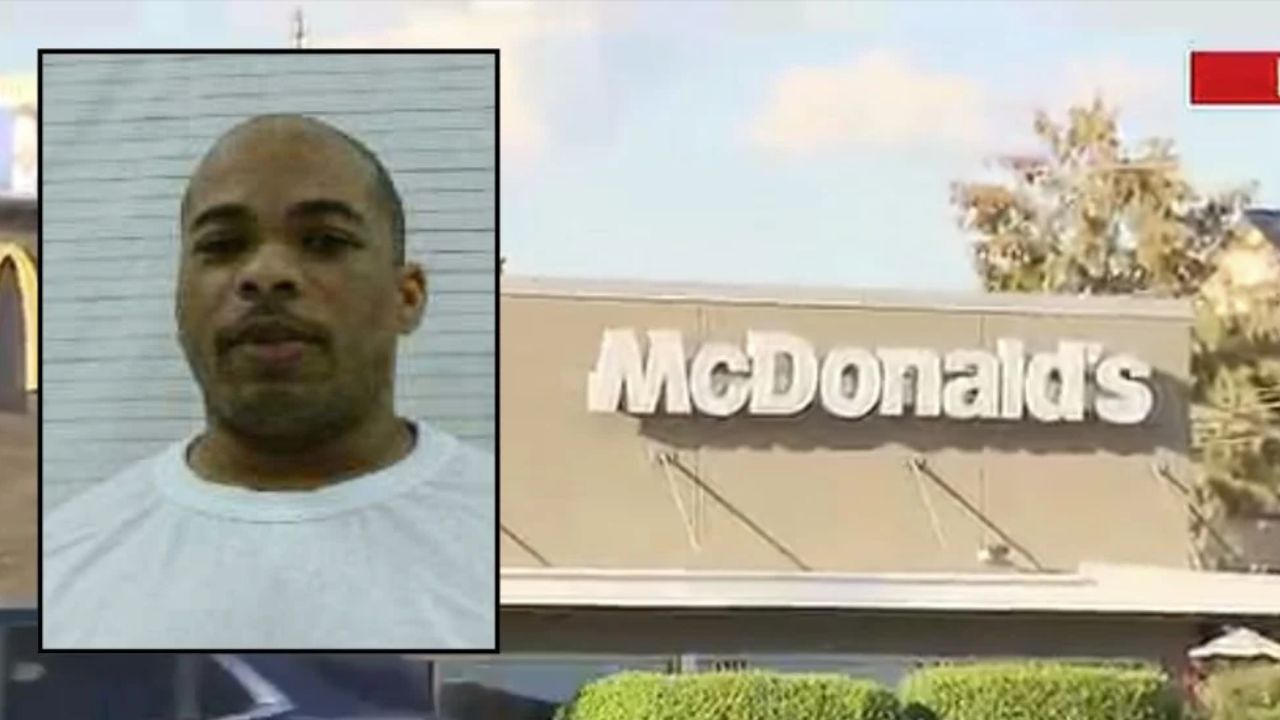
A Fulton County jury has convicted former McDonald’s employee Devin Riley in the shooting death of his co-worker, Quintavious Clark, following a workplace dispute. Riley, 35, was sentenced to life in prison without parole plus an additional 50 years.
Clark, 24, was fatally shot at a McDonald’s in East Point, Georgia, on Feb. 7, 2025. Prosecutors said the shooting came two days after Clark had a verbal confrontation with a female manager at the restaurant. The manager was reportedly Riley’s girlfriend at the time.
According to prosecutors, Riley returned to the restaurant in a rented red sedan at about 2 a.m. while Clark was sitting in his vehicle during a break. Investigators said Riley pulled alongside Clark and opened fire before leaving the area. Security cameras captured the shooting.
The vehicle became an important part of the investigation. Prosecutors said the rental car was equipped with a tracking device, allowing investigators to examine its movements and connect Riley to the vehicle around the time of the shooting.
Investigators also traced the car to an apartment where Riley had been staying before the shooting. Prosecutors said he returned there afterward and removed the vehicle’s license plates.
The surveillance footage did not clearly show the shooter’s face. Prosecutors nevertheless presented other evidence during the case, including information from the vehicle’s tracking system and recorded jail calls. They argued that Riley’s statements during those calls helped establish his involvement in Clark’s death.
Riley has continued to deny that he was responsible. He maintained his innocence during a jailhouse interview with WSB.
The case ultimately ended with Riley’s murder conviction and a sentence that will keep him in prison for the remainder of his life without the possibility of parole, along with the additional 50-year term.
The shooting brought a workplace disagreement to a deadly end and left Clark’s family without a 24-year-old family member. The conviction also shows how investigators used surveillance footage, vehicle-location information and recorded communications together as they built the case against Riley.
