

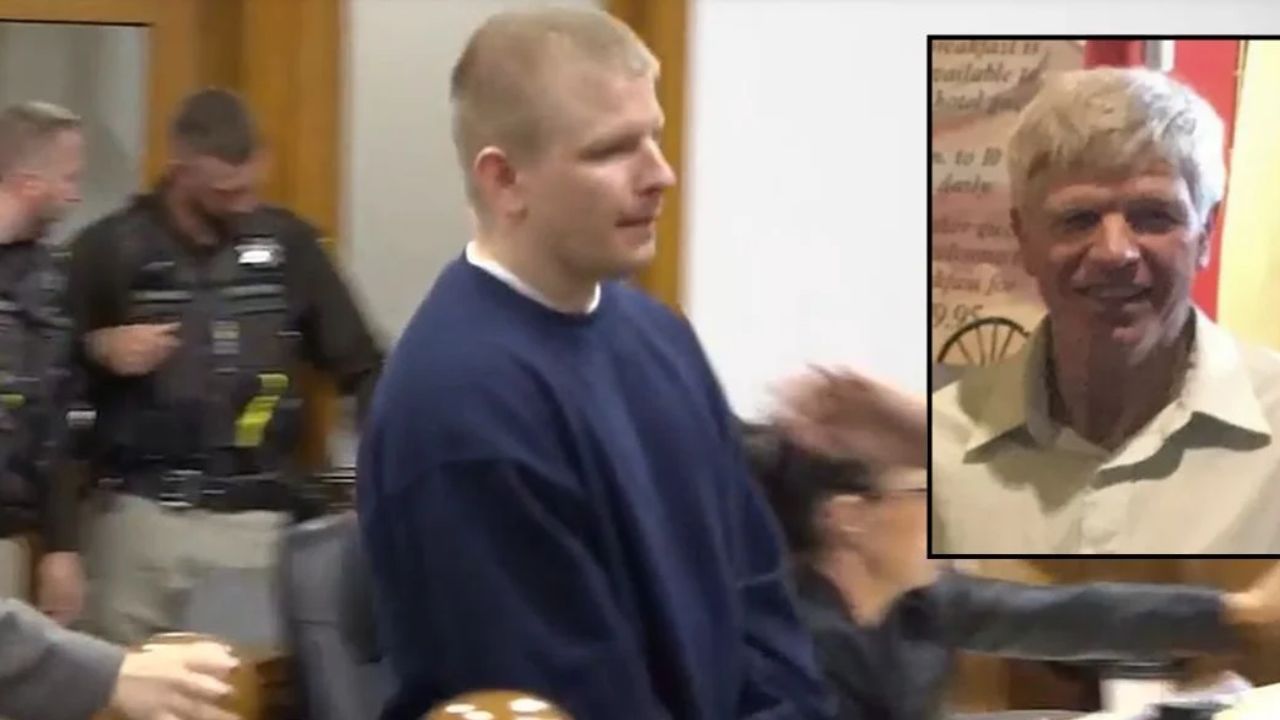
A family argument over money ended in a fatal shooting in northeast Nebraska, leaving a 65-year-old father dead and his son facing the rest of his life in prison.
Carl Ruskamp, 34, was sentenced to life in prison on October 14, 2026, after a jury found him guilty of first-degree murder in the death of his father, Gerald Ruskamp. The killing happened on September 7, 2022, at the family’s home near Wisner, Nebraska.
Investigators pieced together the case using physical evidence recovered from the home, DNA findings and searches recorded on Ruskamp’s phone. The evidence contradicted the account he initially gave authorities about what happened that night.
The case also included questions about Ruskamp’s mental health and whether he was competent to stand trial. Despite those issues, the case proceeded to a jury trial, ending with his conviction in July 2026.
A 911 call and a story about an unknown intruder
Authorities were called to the family home on the evening of September 7, 2022, after Ruskamp reported that his father had been shot.
Gerald was found lying on a couch with a gunshot wound to the head. Carl told investigators that he had been outside smoking when he heard a gunshot coming from inside the house.
He claimed he then saw a man dressed in black running away from the property, suggesting that someone else had entered the home and killed his father.
Investigators continued examining the scene and gathering evidence rather than relying solely on that account. Their search eventually uncovered items that would become central to the prosecution’s case.
Rifle and shell casings discovered inside the home
During a search of the property, investigators found several .22-caliber cartridges in Carl’s bedroom. Additional shell casings were recovered from different areas inside the house and from the ground outside.
Authorities also located a Ruger 10/22 rifle in his mother’s bedroom closet, along with a loaded magazine found in another bedroom.
The location of the rifle became a significant part of the investigation. Prosecutors presented evidence linking Carl to the weapon, including DNA recovered from the rifle.
Investigators also found Gerald’s blood on one of his son’s shirts, adding another piece of physical evidence to the case.
Individually, forensic findings must be considered alongside the wider evidence. In this case, prosecutors presented the recovered firearm, biological evidence and digital records as part of the case that ultimately resulted in a guilty verdict.
Phone searches made days before the shooting
One of the most troubling elements of the investigation emerged when authorities examined Carl’s phone.
Records showed that several days before his father’s death, on September 3, 2022, he searched for information involving gunshot wounds to the head and the human brain.
The searches included phrases such as “headshot to the head,” “bullet in brain” and “brain stem location.”
These searches took place just four days before the fatal shooting, according to the reported timeline. Investigators treated the digital records as evidence relevant to their examination of what happened inside the home.
Phone searches alone do not establish exactly what a person intended or prove a crime by themselves. However, prosecutors presented them alongside the physical evidence, the recovered rifle and the circumstances surrounding the shooting.
The combination of these findings helped build the case against Ruskamp as investigators worked to determine whether the account of an unknown intruder was credible.
An argument over money preceded the killing
The prosecution’s account also focused on a disagreement between father and son over money.
According to the reported case details, Carl had argued with Gerald on the day of the shooting because his father would not give him money to buy a car and obtain an apartment.
The disagreement became an important part of the timeline presented in the case. Authorities examined the dispute alongside the evidence collected from the property and the searches found on Carl’s phone.
The available reporting does not establish that the financial disagreement alone explains everything that led to the shooting. What is clear is that prosecutors presented it as relevant context for the events of that evening.
For families affected by violent crime, cases involving relatives can be especially difficult because the loss extends beyond the immediate victim. Prosecutors said Gerald’s death had profoundly affected the family, and no family members attended the sentencing hearing.
Defense raised concerns about mental health
Ruskamp’s defense challenged whether he was competent to stand trial, citing a diagnosis of schizophrenia.
The defense also raised concerns about the mental health system and argued that there had been periods before the shooting when Ruskamp was experiencing delusions and had contact with law enforcement.
A psychologist retained by the defense reportedly concluded that Ruskamp was not legally insane at the time of the shooting.
Competency to stand trial and legal insanity are separate questions. Competency concerns whether a defendant can understand the proceedings and assist in their own defense. Insanity concerns a defendant’s mental state at the time of the alleged offense under the applicable legal standard.
A mental health diagnosis, by itself, does not automatically establish either incompetence or legal insanity. Those issues depend on the evidence and the relevant legal requirements.
The case ultimately went to trial, and a Wayne County jury found Ruskamp guilty on July 29, 2026.
Judge imposes additional prison terms
At sentencing on October 14, Judge Michael Long ordered Ruskamp to serve life in prison for first-degree murder.
He also received a sentence of 20 to 50 years for using a weapon to commit a felony and 10 to 20 years for possessing a deadly weapon as a felon.
The sentences were ordered to run consecutively, meaning they are served one after another rather than at the same time.
Ruskamp did not make a substantive statement during the sentencing hearing, according to courtroom reporting. He responded to the judge’s questions but offered no extended remarks.
Assistant Nebraska Attorney General Beth Beninato described the case as a devastating loss for the family, saying the killing had completely destroyed it.
The life sentence means Ruskamp will remain incarcerated for the rest of his life under the sentence imposed for the murder conviction.
A case that leaves lasting questions
The investigation into Gerald Ruskamp’s death relied on several types of evidence, including physical items from the home, DNA findings, digital searches and information about the dispute that preceded the shooting.
The case also highlighted the legal distinction between mental illness, competency to stand trial and criminal responsibility. Those issues can be complicated, particularly when a defendant has a documented psychiatric history, but they must be evaluated under specific legal standards.
For Gerald’s family, the outcome cannot undo the loss. The sentencing brought the criminal proceedings to a major conclusion, but prosecutors said the impact of his death will remain with those who knew him.
Carl Ruskamp is now serving a life sentence for killing his father, with additional consecutive prison terms imposed for the weapon-related convictions.
