

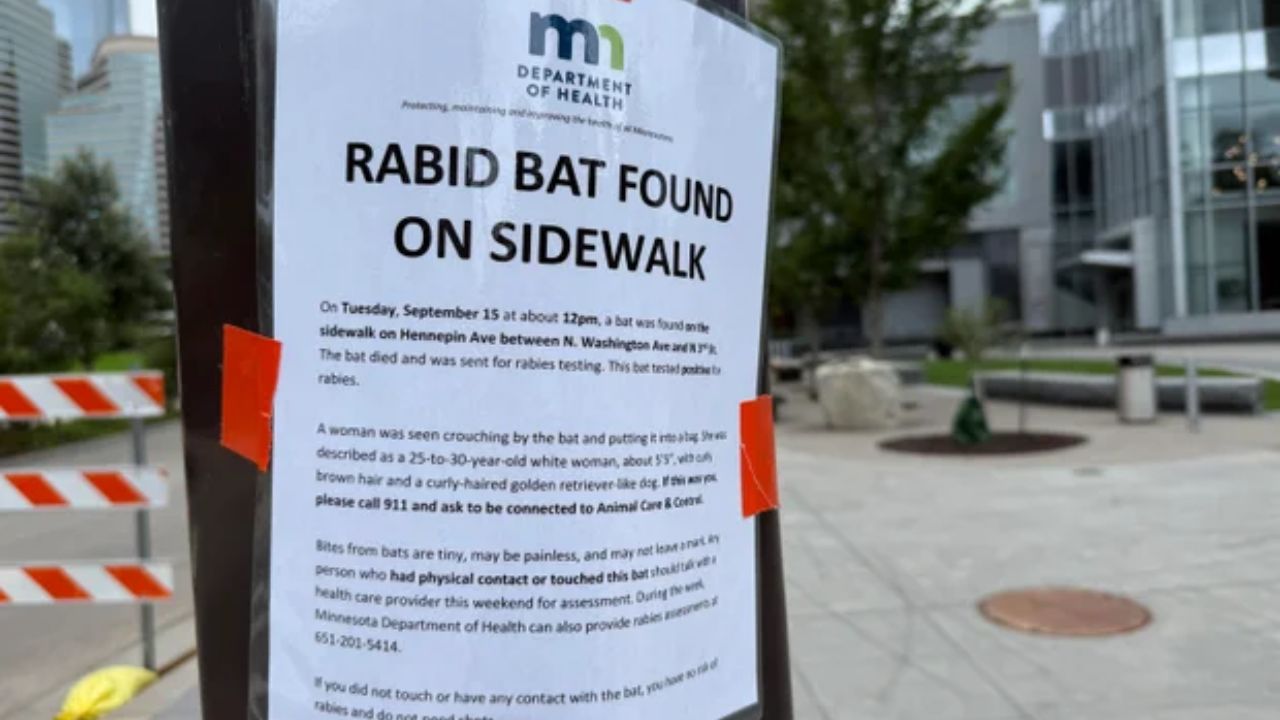
MINNEAPOLIS — Minnesota health officials are asking for the public’s help locating a woman who was seen handling a bat in downtown Minneapolis after the animal was later confirmed to have rabies.
The bat was found around noon Tuesday on Hennepin Avenue between North Washington Avenue and North Third Street. According to the Minnesota Department of Health, a woman believed to be between 25 and 30 years old was seen crouching near the bat and placing it into a bag.
Officials described the woman as about 5 feet 5 inches tall with curly brown hair. She was also with a curly-haired dog resembling a golden retriever.
The woman reportedly handed the bat to another passerby, who submitted the animal for rabies testing. Health officials later received laboratory results confirming that the bat was infected with the virus.
Because rabies can be transmitted through direct contact with an infected animal, officials want to determine whether the woman or anyone else who handled the bat may have been exposed.
Anyone who believes they touched the bat is being urged to seek medical guidance. Health officials say people with a potential exposure should contact 911 and ask to be connected with Animal Care and Control, as well as contacting their healthcare provider.
Bat contact can be difficult to recognize
One reason officials are concerned is that a bat bite may be extremely small and can sometimes go unnoticed. Minnesota health guidance says bat bites may leave little or no visible mark, so physical contact with a bat can warrant an assessment for rabies exposure.
Rabies affects the nervous system and is fatal once symptoms develop. However, the disease is preventable when appropriate post-exposure treatment is given before symptoms begin. Minnesota health officials recommend medical evaluation after direct physical contact with a bat.
The state’s health department says bats are among the animals that commonly carry rabies in Minnesota. Its latest statistics also show that bats are particularly active during late summer, when young bats begin leaving maternity roosts, increasing the chances of encounters with people. From 2016 through 2025, about 4.1% of bats submitted for testing in Minnesota were positive for rabies.
The concern comes as health officials across the country have also reported increased activity surrounding rabies exposure. The Centers for Disease Control and Prevention said it received 17% more rabies-related inquiries from July through August 2026 than during the same period in 2025. The agency also reported increases in rabies post-exposure treatment use during that period.
Minnesota has also documented how serious an unrecognized bat exposure can become. The state reported a human rabies death in 2024 involving a person who had been exposed to a bat but did not initially recognize the interaction as a potential rabies risk.
Health officials are therefore urging anyone who may have touched the Minneapolis bat not to assume that an absence of a visible bite means there was no exposure.
The woman authorities are seeking, along with anyone else who may have had direct contact with the animal, should contact health professionals as soon as possible to determine whether rabies prevention treatment is needed.
