

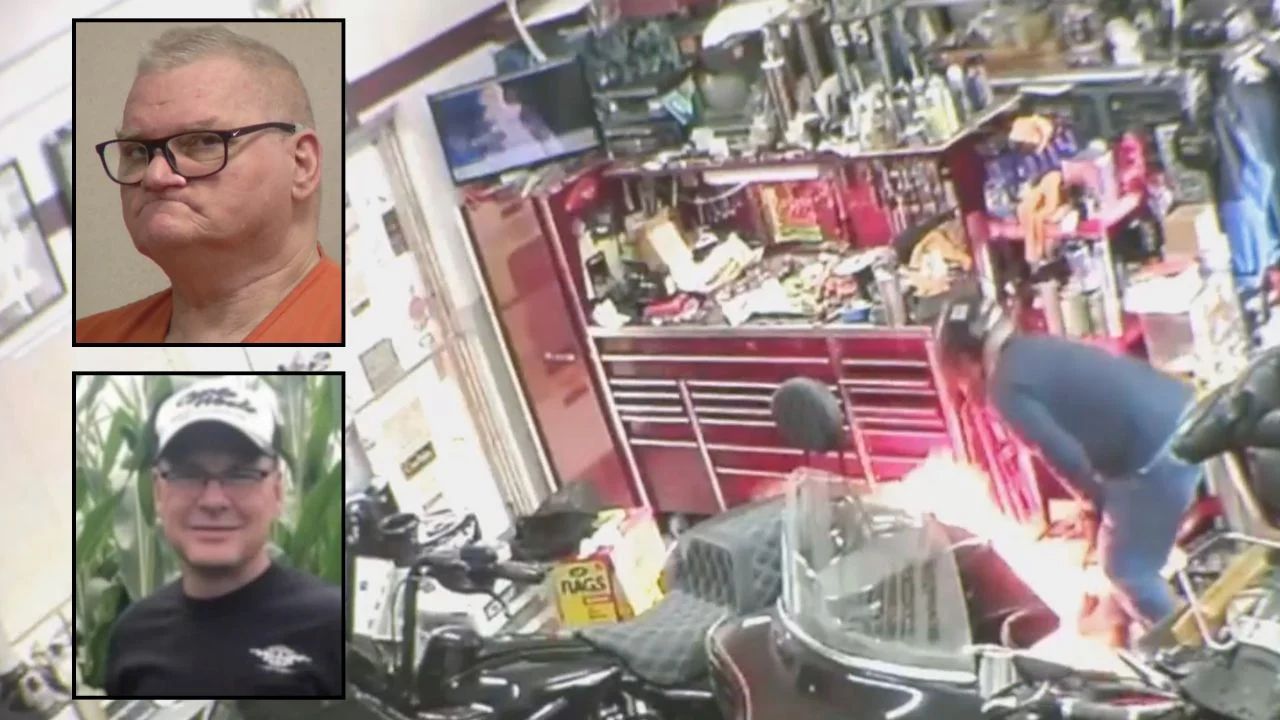
A former Florida police officer and firefighter has been sentenced to death for the 2021 killing of a motorcycle shop owner who was shot multiple times before being doused with flammable alcohol and set on fire.
Otto Lenke, 67, received the sentence Wednesday from Circuit Judge Michael Linn for the murder of Richard Benson at Fast Frank’s motorcycle shop in Fort Pierce, Florida. The judge described the killing as a carefully planned attack carried out with extreme cruelty.
The sentencing follows a jury’s decision in May to convict Lenke of first-degree murder with a firearm and first-degree arson. Jurors subsequently recommended the death penalty in an 11-1 vote.
According to court records, the jury found three aggravating factors that supported the death sentence: the murder was especially heinous, atrocious or cruel; it was committed in a cold, calculated and premeditated manner; and it occurred during the commission of another felony, arson.
Lenke’s case will undergo review by the Florida Supreme Court before an execution can proceed.
A Carefully Planned Attack
The killing took place on February 17, 2021, when Benson arrived at Fast Frank’s to open the motorcycle business for the day.
Court records describe how Lenke allegedly prepared for the attack before driving to the shop. He removed the license plate from a car and traveled approximately 40 minutes to Fort Pierce. After parking away from the business, he waited before putting on a motorcycle helmet with a tinted face shield and gloves.
He was carrying a handgun, two lighters and two containers of denatured alcohol, a highly flammable substance.
Lenke entered through a rear door and approached Benson, who was working at a bench near the front of the shop.
The sentencing order states that Lenke shot Benson in the back at close range. When the wounded shop owner fell near the front entrance and partially opened the door, Lenke dragged him back inside.
Benson reportedly raised his hands toward the attacker. Lenke then shot him in the chest.
Despite his injuries, Benson attempted to crawl toward the exit. According to the court’s account, Lenke pulled him away from the door again before shooting him a third time.
The attack continued after the final gunshot. Lenke poured the flammable liquid over Benson while he was still moving and set him on fire.
In his sentencing order, Judge Linn said the evidence showed that Lenke had carried out a deliberate plan to kill Benson in an exceptionally cruel manner. The judge concluded that the death penalty was the appropriate punishment after independently reviewing the evidence and circumstances of the case.
Investigators Traced the Vehicle and Examined Digital Evidence
Investigators pieced together evidence from surveillance footage, vehicle records, cellphone data and a search of areas connected to Lenke.
A Pontiac Bonneville seen near the motorcycle shop was linked to a vehicle registered to Lenke but primarily used by his daughter. Surveillance footage showed the car traveling toward the business, parking nearby and later leaving without a license plate.
Cellphone records placed Lenke’s phone at his residence around the time of the murder, according to the sentencing documents. Investigators also tracked movements after the killing that led them to his hobby shop, a canal and a shoreline area of the Indian River Lagoon near Sebastian.
Authorities recovered part of a Glock firearm from the lagoon area. Court records stated that the recovered portion was consistent with the murder weapon. However, the records did not establish who had originally purchased the firearm secondhand.
The evidence described in the sentencing order helped prosecutors present the killing as a planned crime rather than a spontaneous confrontation.
A Relationship Dispute Behind the Killing
The case involved a romantic rivalry, and the supplied court account describes Lenke’s questions about why a woman did not love him. The sentencing outcome, however, rested on the murder and arson charges, the evidence presented at trial and the aggravating circumstances identified by the jury.
The court’s findings emphasized the preparation that preceded the attack, the repeated attempts to prevent Benson from reaching the exit and the use of fire after the shooting.
Those details were central to the judge’s conclusion that the crime involved both advance planning and extraordinary cruelty.
What Happens Before an Execution?
Although Lenke has been sentenced to death, the punishment will not be carried out immediately.
Under Florida’s capital punishment process, the Florida Supreme Court must review the case before an execution can proceed. That review is an important legal safeguard in death penalty cases, allowing the state’s highest court to examine issues related to the conviction and sentence.
The jury’s 11-1 recommendation supported the death penalty, but the sentencing decision also required the judge to independently evaluate the legal findings and aggravating circumstances.
The case now moves into the next stage of the judicial process.
For Benson’s family and those who knew him, the sentencing marks a significant development in a case that began with a deadly attack inside a motorcycle shop. For Lenke, it means facing the most severe punishment available under Florida law, subject to the required court review.
The outcome brings the trial and sentencing phase to a close, but the legal process must continue before the state can carry out the sentence.
