

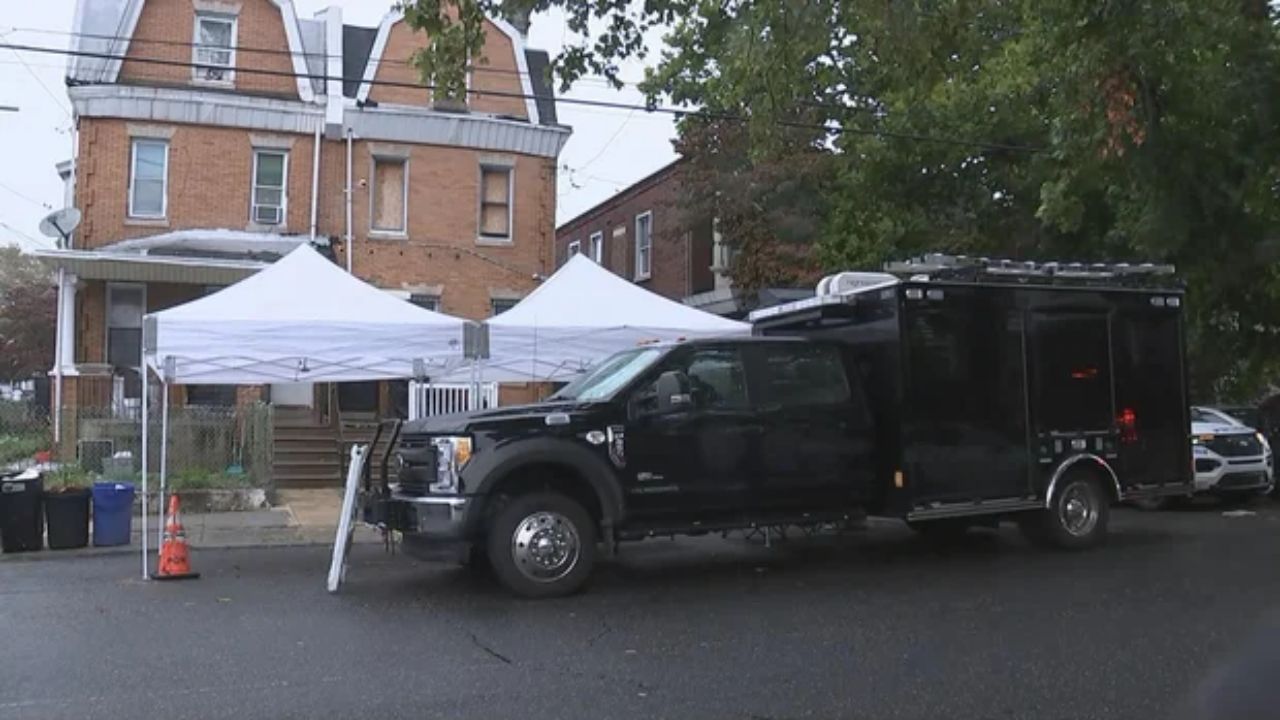
The investigation surrounding a home on West Chew Avenue in Philadelphia’s Olney neighborhood is entering a new phase, with police and federal investigators preparing to remove portions of the property as they search for physical evidence.
The house at 417 W. Chew Ave. has become the center of an expanding investigation involving seven missing women. Five of those women are feared dead, although authorities have not recovered the bodies of those believed to have been killed.
Investigators from the Philadelphia Police Department and FBI were at the property Monday, establishing a secured perimeter around the home. Authorities are also using three-dimensional photography to document the interior and exterior of the building.
The next stage is expected to involve a much closer examination of the home’s structure. Investigators are looking at materials including flooring, drywall and plaster and may remove sections of the interior based on what they have found while reviewing the enormous collection of digital evidence recovered from the property.
Police have identified 58 women in photographs and videos recovered from the house. Investigators are examining that material for evidence that could help determine what happened to women who disappeared and whether additional crimes occurred at the property.
Investigation grew after Eugene Horsch’s arrest
The case came into sharper focus after Eugene Horsch was arrested in June on federal gun and drug charges.
During the incident that led to his arrest, authorities found weapons, drugs and fake DEA credentials. A woman who was with Horsch reportedly provided identification belonging to Blair Tonzelli, a woman who had been reported missing in 2023. That discovery prompted investigators to take another look at the Chew Avenue property.
Federal and local authorities subsequently obtained search warrants for the home.
Inside the property, investigators found a basement containing chemicals and equipment that police described as an elaborate laboratory. They also recovered other evidence, including digital storage devices containing hundreds of thousands of images and videos. Testing of substances found at the property remains part of the investigation.
Authorities have also previously searched the yard as they looked for physical evidence connected to the missing women.
Seven women are now linked to the investigation
The number of women connected to the case has grown as detectives have continued examining the digital material.
Three women — Gabrielle Amarando, Maribel Fresses and Nicole Fusaro — are believed by investigators to have been killed. Their remains have not been recovered, and their deaths have not been formally ruled homicides by the medical examiner.
Blair Tonzelli and Amy McHale are among the women who remain missing. McHale, who was previously married to Raymond “R.C.” Horsch, was reported missing in 2016 and was last seen at the Chew Avenue property, according to reporting on the investigation.
Police have said Eugene Horsch has not been charged in connection with the disappearances. He remains in federal custody on the weapons and drug charges from his June arrest.
More evidence could be recovered from the house
The enormous volume of digital evidence has made the investigation a lengthy process. Police have been reviewing more than 1 million photos and videos while trying to identify people shown in the material and determine whether the images document real crimes or staged scenes.
Recent reporting has also brought additional people and possible connections into the investigation. Investigators continue to determine whether the evidence points to further victims or previously unidentified incidents.
The physical search is now expected to expand beyond the initial processing of the property. Heavy construction equipment is expected at the site, and portions of Chew Avenue will be closed during scheduled investigative work.
The 400 block of Chew Avenue is scheduled for traffic closures near Lawrence Street on Sept. 28 and 29 from 7 a.m. to 5 p.m. A later phase, scheduled for Oct. 5 through Oct. 16, is expected to require residents to move parked vehicles during daytime hours.
For neighbors, the continuing police presence has brought an unsettling investigation directly into the surrounding community. But for detectives, the focus remains on what can be established through physical evidence, forensic testing and the massive digital archive recovered from the home.
As investigators begin taking apart portions of the property, they will be looking for evidence that could help answer some of the biggest unanswered questions in the case — including what happened to the missing women and whether additional victims are connected to the Chew Avenue home.
